
How much DSP does a Line 6 Helix block use?
Every Helix and HX path has one DSP budget, and a block spends a share of it. A compressor might take 2%, a reverb 10%, a full amp close to 30% — and running the same block in stereo costs roughly twice what mono does. Helrig estimates the total for each path as you edit, so you can see the ceiling coming rather than meeting it.
How many budgets you have
One per DSP path, each full at 100%. A Helix Floor, LT or Rack has two independent paths, so two separate budgets. HX Stomp and HX Effects have one, which can still be split into parallel branches — but both branches draw on the same budget.
That is why a preset moved from a Helix to an HX Stomp can fail to fit even when the block count looks fine: two paths of headroom became one.
What blocks actually cost
A percentage of one path, at the block’s real width. Examples from the block catalog:
| Block | Category | Mono | Stereo |
|---|---|---|---|
| Deluxe Comp | Dynamics | 2.3% | 4.0% |
| Simple Delay | Delay | 4.4% | 6.1% |
| Scream 808 | Distortion | 7.3% | 13.4% |
| Transistor Tape | Delay | 8.3% | 15.5% |
| Ganymede | Reverb | 10.0% | 17.7% |
| US Deluxe Nrm | Amp | 29.6% | — |
| US Deluxe Nrm | Amp + Cab | 33.0% | — |
| US Deluxe Nrm | Preamp | 13.5% | — |
The three rows for the same amp are the useful ones. As a full Amp it costs 29.6% of a path; as an Amp + Cab 33.0%; as a Preamp only 13.5%. Swapping an amp for its preamp version is usually the single biggest saving available on a crowded path, and it is the first thing to try when a preset will not fit.
Seeing this on your own preset
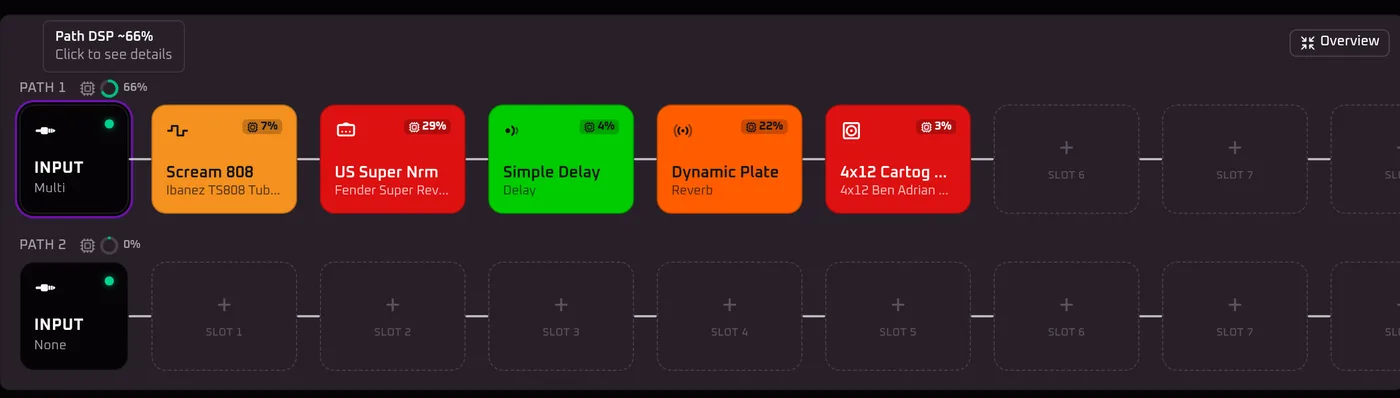
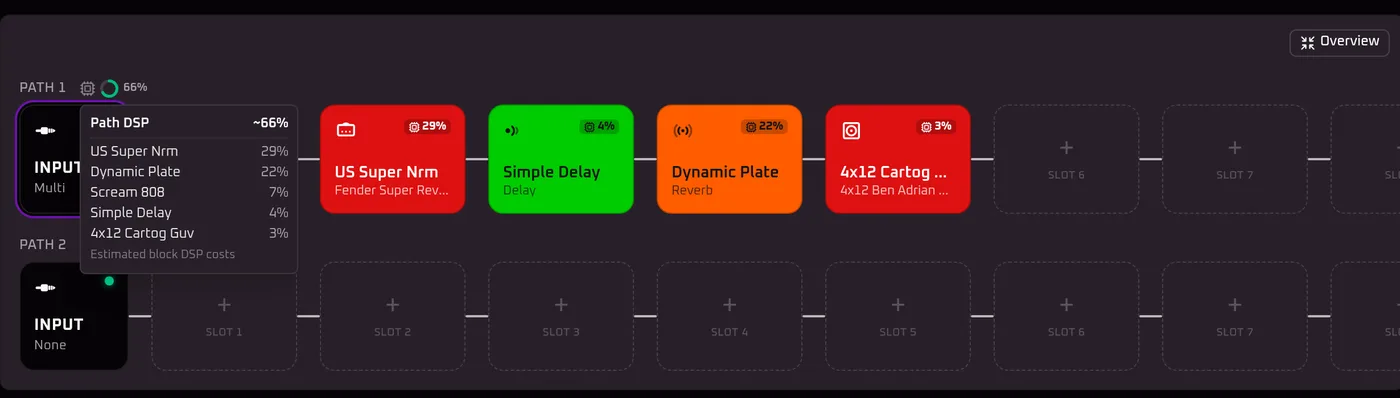
Every path carries a meter. Hovering it flags each block on that path with its own cost; clicking opens the whole breakdown, largest first — which is usually enough to see where the budget went.
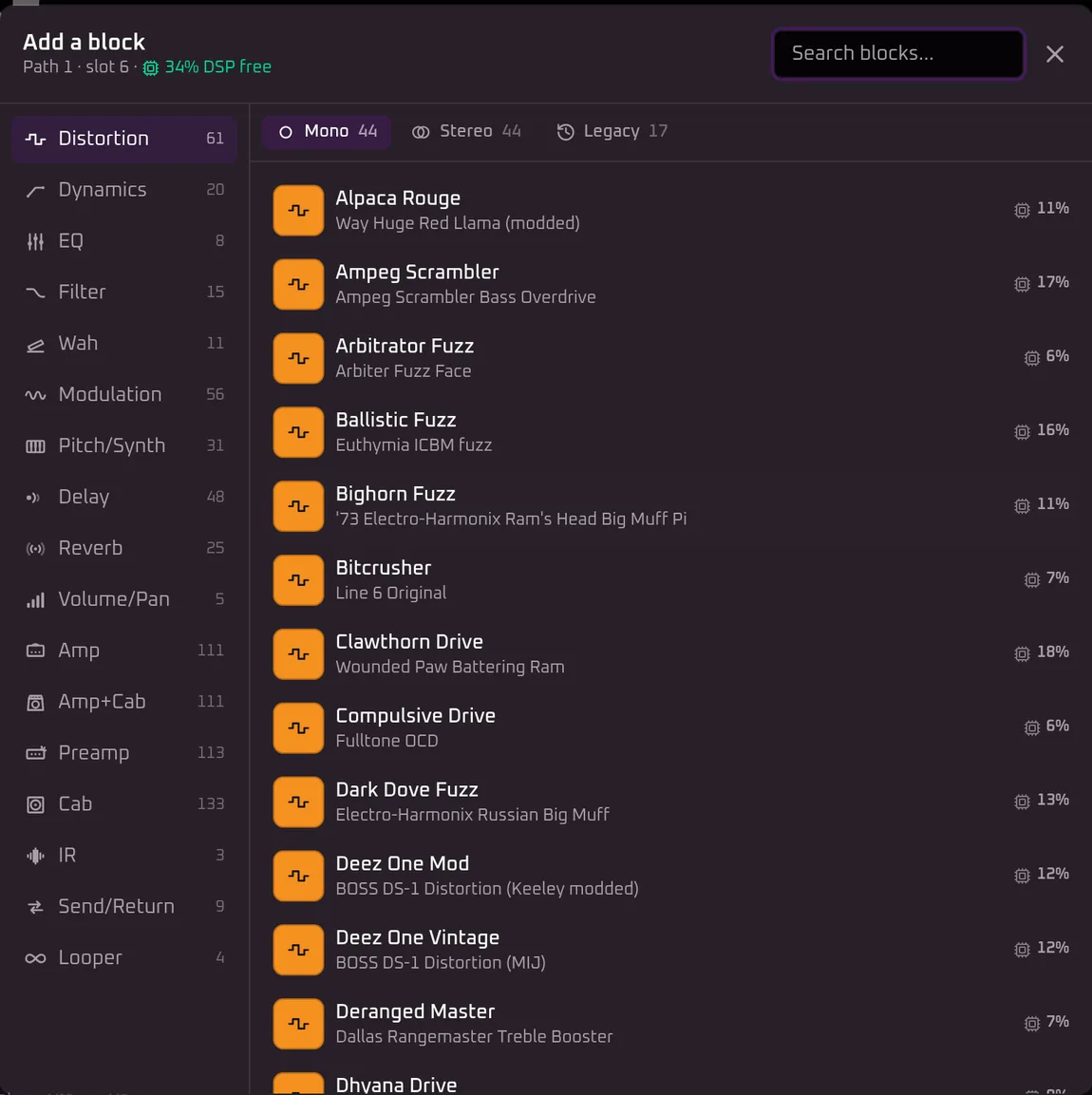
The block catalog does the same arithmetic before you commit to anything: it heads the list with how much of the path is still free and prices every block beside its name. Anything that would not fit is disabled rather than left to fail after you add it.
Three rules that decide the total
- Stereo costs about double. A block is charged the figure matching the width it actually runs at, not its cheapest. Amps and cabs run mono — the signal collapses to mono going into an amp — while time-based effects default to stereo.
- Bypassing a block frees nothing. The hardware keeps a bypassed block loaded, so it still occupies its share. Only removing it gives the DSP back.
- Structure is free. Inputs, outputs, and the split and join markers cost nothing. It is the models that spend the budget.
The other limit nobody mentions: cab and IR slots
Cabs and impulse responses are cheap in DSP terms but draw on a separate resource — the convolution engine holds a fixed amount of impulse data per path, capped at two slots. Amps and effects are unaffected by it.
There are two independent pools of two:
- Modern. Modern cabs are themselves IR-driven, so they share this pool with IR blocks. A path takes two mono cabs, or two standard IRs, or one of each.
- Legacy. The older algorithmic cabs have their own pool, so they never crowd out a modern cab or an IR.
A dual or stereo cab, and a 2048-sample or dual IR, each load twice the data and cost two slots — so one of them fills a pool by itself.
This matters because exceeding it is silent. The device does not warn or refuse: the block is simply dropped, which usually shows up as a preset that exported fine and then came back missing its cab. Helrig tracks both pools per path, so you’re warned before a preset leaves in that state.
Where these numbers come from
Line 6 publishes no per-block percentage. The catalog carries HX Edit’s own internal load figures, which are not percentages — a full path holds about 75 of those units, the rest of the chip going to fixed input, output and routing overhead. Helrig scales them by 4/3 so that 100% means the device’s real ceiling.
That coefficient was calibrated, not assumed: six presets were put to HX Edit, three it opened and three it refused, and the split fell cleanly at a raw sum of 75. It also independently matches benvesco’s published HX DSP figures, which are the same raw values scaled the same way.
So treat these as good estimates rather than the device’s own arithmetic. They are verified against HX Stomp behaviour, and the HX family shares the same DSP per path, so they apply per Helix path too — but a firmware change could move them.
Disclaimer
Helrig is an independent, one-person project. It isn’t built by, affiliated with, or endorsed by Line 6 or Yamaha — “Line 6”, “Helix” and “HX” are their trademarks.